Showing posts with label Articles. Show all posts

Friday, January 22, 2021

Late Winter Pruning

 LATE WINTER PRUNING 2021


Late January through the end of February is THE time for pruning most shrubs, trees, perennials, and ornamental grasses in North Texas, Zone 8.   

Here's my latest -- click here 👉-- LATE WINTER PRUNING Newsletter  with how-to tips to tackle all your garden pruning to get ready for spring growth.  

Happy pruning!

Toni :-)

Follow me on Facebook and Instrgram @tonisignaturegardens

Friday, January 29, 2016

The 10 Best Dallas Suburbs - Grapevine

In a tie for the #4 spot, Grapevine was recently featured as one of the 10 best Dallas suburbs to live in.  Check out the article here


As wonderful as it was that Grapevine made the top 10 list, what made it even more special is that it was a picture of my yard was chosen to represent our fair city!    How cool is that?!!!    What an honor!

Grapevine is #1 in my book :-)

Happy Gardening in 2016!

Toni :-)

P.S.  As you can tell by the date of the previous post, I've been a little absent from my blog the past year.  I've been hanging out over on Facebook, so "like" my page:  Signature Gardens


Tuesday, December 20, 2011

Every Kiss Begins With...Mistletoe?


And you thought Kay Jewelers had the corner on this market, didn’t you?

There are several theories on the origin of the tradition of kissing under the mistletoe.  One theory dates back to ancient Norse mythology.    The Reader’s Digest version of the story is that the son of the goddess Frigg was killed with a spear made of mistletoe.  When the son, Baldr, was brought back to life, Frigg declared that from that point on mistletoe would bring love rather than death into the world. People kissed under the mistletoe to remember Baldr’s resurrection, bringing the promise of happiness and good luck in the following year.   

Folklore abounds when it comes to mistletoe.    Another legend dates back to the ancient Babylonian-Assyrian Empire where mistletoe was hung outside the temple for the goddess of beauty and love.

Mistletoe was also seen as a supernatural healing plant, and the Greeks believed it to be an aphrodisiac that promoted fertility.  It was even put under the beds of newlywed couples to bring good luck.

In Scandinavia, mistletoe was considered a plant of peace.  Under the peace-promoting plant, enemies could declare a truce or warring spouses would kiss and make up.   In Europe, branches of mistletoe were hung from ceilings to ward off evil spirits.

In England young men would kiss women standing under the mistletoe and would pluck a berry from the bush after each kiss. After all the berries were gone, it was bad luck to continue kissing under that bush.

With all that love, peace, and kissing attributed to the mistletoe, you’d think everyone would be clamoring to have one or two.  But this is where the romance ends, my friends.

The Old English (Anglo-Saxon) word for Misteltoe was mistiltan --   "Mistel" meaning "dung" and "tan" meaning "Twig", i.e., "Dung-on-a-twig."   Not so lovely anymore, is it?     


Mistletoe produces a white berry that is part of the diet of many birds.  The seeds are coated with a sticky gelatinous substance.  When the seeds are excreted in bird droppings, the seeds stick like glue to twigs and limbs until they germinate.

When the mistletoe seeds germinate, root-like structures called haustoria penetrate the bark and grow into the xylem (the water conducting tissue of the tree limb.)  Mistletoe is a parasite that lives off the tree as its host.  The water and nutrients needed for its growth and development are taken from the tree’s sap.

Small limbs infested with mistletoe can be pruned.  Limbs must be cut at least 12 inches beyond where the mistletoe attaches to the limb in order to completely remove the embedded root system.

 
When mistletoe is growing on large limbs or on the tree’s trunk, pruning is no longer practical.   

Just cut the mistletoe off flush at the point it attaches to the limb or trunk.  Only mature plants (2-3 years old) produce berries.  You may reduce the spread of the plant if you can remove the mistletoe plant before it reaches maturity and produces seeds. 


Another option is to cut off the mistletoe plant and then wrap the area with a few layers of black plastic for one to two years.    This may be an effective control of the plant, since mistletoe also requires chlorophyll and sunlight in order to survive.  Once again, the size of the tree and location of the mistletoe will determine how practical it is to try this technique.  Safety first!

There is currently no herbicide recommended for the control of mistletoe in trees.  Because the mistletoe’s haustoria basically become intertwined with the tree’s vascular system, chemical controls could cause injury to the tree. 

Some trees seem to be more susceptible to mistletoe.   Cedars, junipers, pecan, live oak, and magnolia trees are rarely infected with mistletoe.   However water oak, Spanish oak, elm, and hackberry trees are frequently infested with this parasite. 

So does having mistletoe mean the kiss of death for your tree?  Not necessarily.  Mistletoe may not kill a tree outright, but heavily infested limbs are stressed, and this can increase the tree’s susceptibility to other problems.     


Now that the trees are dropping their leaves this winter, the evergreen mistletoe will be very visible.      Hopefully you can safely remove it, and you and your trees can kiss this parasite goodbye! 

I hope the only mistletoe you find this year is the kind that brings a little love, peace, and a kiss or two. 

Toni :-)

Friday, November 18, 2011

Survivor: Texas (Garden Edition)


Now that the record-breaking summer of 2011 is safely behind us, I got to thinking....if gardening during a Texas summer were a TV reality show, could you bear to watch?   Oh, there would be plenty of drama, that's for sure, with lots of whining and crying and pouting.  Sadly, though, there wouldn't be much singing or dancing.  In fact, most episodes would seem rather dry.  Everything would be in need of an Extreme Makeover, and you'd end up feeling like the Biggest Loser. But one thing you could count on is that it would be very hot and steamy.   So tune in, you may even find a new Idol and a few Survivors.

Seriously, though, the reality of a Texas summer is that it is just plain HOT.   And the Summer of 2011 was the hottest of 'em all.  Yes, Dallas/Fort Worth is now officially in the record books as the summer with the most 100-degree days.  70 days.  I finally feel vindicated for all of that whining, crying, and pouting!

1980 still holds the record for the most consecutive 100-degree days (42), but 2011 missed it by just two days and a few degrees. Hopefully that torch has been extinguished, never to be lit again.

Needless to say, this hot and dry summer episode took its toll on our gardens.   Yet in spite of it all, there are SURVIVORS.

The words “water restrictions” seem to strike fear in the heart of every gardener.    Don’t spend the next summer season battling the elements.   Turn the challenges of this summer into opportunities to make your garden better by choosing more drought-tolerant plants that have proven their worth.

Let's take a look at some of the players, marooned in the seemingly desolate locale otherwise known as...my garden.   My “tribes” of plants faced daily endurance challenges and overcame many obstacles, yet some seemed immune to elimination.

Since I am the sole member of my garden's “Tribal Council” and “jury,” here’s a list of the plants that were star performers in my garden this summer and are deserving of my vote.

Salvias are the workhorses of my garden!

'Henry’ and ‘Augusta’ Duelberg (Salvia farinacea)
Autumn Sage (Salvia greggii)
Mexican Bush Sage (Salvia leucantha)
Russian Sage (Perovskia atriplicifolia)

  Zexmenia (Wedelia hispida) is extremely drought tolerant


'Azure Skies' Heliotrope blooms all summer and attracts bees


Purple Heart
(Tradescantia or Setcreasea pallida) 
is tough as nails!

 Ornamental grasses are must-haves!

Mexican Feathergrass (Nasella tenuissima)
Hameln Fountain Grass (Pennisetum alopecuroides ‘Hameln’
Lindheimer’s Muhly Grass (Muhlenbergia lindheimeri)
Pink Muhly Grass (Muhlenbergia capillaris)
Miscanthus sinensis ‘Adagio’ (Dwarf Maiden Grass)
Black Fountain Grass (Pennisetum ‘Moudry’)
Fountain grass ‘Karley Rose’ (Pennisetum orientale 'Karely Rose')

 'Karley Rose' beat the heat with ease!

More great plants for SUN:

Pink Skullcap (Scutellaria suffrutescens)
Dwarf Mexican Petunia (Katie’s Ruellia)
‘Powis Castle’ Artemisia
Mexican Milkweed (Asclepias curassavica)
Lantana camara
Red Yucca (Hesperaloe parviflora)
Gray Creeping Germander
Canna
Datura
Thyme
Rosemary
Mexican Mint Marigold (Tagetes lucida)
Rudbeckia ‘Triloba’
Flame Acanthus (Anisacaths wrightii)
Texas Star Hibiscus
‘Bath’s Pink’ Dianthus
Four Nerve Daisy (Tetraneuris scaposa)
Variegated Liriope ‘Silvery Sunproof’ (with afternoon shade)
Sedum
Pink Rain Lily (Zephyranthes grandiflora)
Yaupon Holly
Burford Holly
‘Gulfstream,’ ‘Nana,’ and ‘Harbor Dwarf’ Nandina
Yaupon Holly tree
Crape Myrtles
Redbuds: ‘Burgundy Heart,’ ‘The Rising Sun,’ and ‘Oklahoma’
Rose of Sharon (Althea)

Lots of shady characters were star performers as well


Native Turk’s Cap
(Malvaviscus arboreus) 
attracts hummingbirds


Another native, American Beautyberry 
(Callicarpa americana), 
attracts our feathered friends


Hostas absolutely fried, but Leopard Plant (Ligularia/Farfugium) survived with no special care


African Hosta
(Drimiopsis maculata) 
is not bothered by slugs, snails, or heat


 More great plants for SHADE:

Cast Iron Plant (Aspidistra)
Oakleaf Hydrangea
Chocolate plant (Pseuderanthemum alatum)
Purple Shamrock (Oxalis triangularis)
Forsythia Sage (Salvia Madrensis)
Holly Fern (Cyrtomium falcatum)
Purple Heart (green variety)
'Tropical Giant' Spider Lily (Hymenocallis)
Horseherb (Calyptocarpus vialis)
Ajuga ('Giant,' 'Chocolate Chip')
Cherry Laurel

Heat Loving Annuals
 Melampodium
Vinca (periwinkles)
Angelonia ‘Serena’ series


Blue Daze (Evolvulus glomeratus) loved the heat!


Variegated Tapioca (Manihot esculenta) was still going strong in mid-August!


Caladiums can't be beat
for a shady spot.


More great annuals for sun and shade:

Cosmos
Salvia coccinea (red and ‘Coral Nymph’)
Malabar Spinach (vine)
Esperanza (Tecoma stans)
Lantana
‘African Blue’ Basil
Holy Basil
Lemon Verbena
Sweet Potato Vine
Perilla magilla
Hyacinth Bean Vine
Ornamental peppers
Pentas (in afternoon shade)
Begonias (shade)

Some of my plants got sent to Redemption Island.   They started out strong, but then quickly burned out when the heat was intense.   After a disappointing debut, they have redeemed themselves this fall showing some recovery now that cooler temperatures and some rains have returned.

Black-Eyed Susans (Rudbeckia ‘Goldsturm’)
Summer Phlox (Phlox paniculata)
Black & Blue Salvia (Salvia guaranitica )
Lamb’s Ear ‘Helen von Stein’
Wood Fern (Dryopteris)
'Texas Gold' Colubmine (Aquilegia chrysantha hinckleyana)
‘Gold Dust’ Aucuba
Autumn Joy Sedum
Knock-Out Rose 'Rosa Radrazz'

Unfortunately some plants went to Dead Man’s Island:

Eupatorium ‘Chocolate’
Hostas
Shasta Daisy (Leucanthemum)
‘Endless Summer’ Hydrangea is on its last legs

Thankfully the list of winners is much longer than the list of losers (hence this ridiculously long post).  If any plant survived the Winter and Summer of 2011, it is a keeper in my book.  If this challenging summer (and winter) has wreaked havoc in your garden, incorporate some of these well-adapted plants into your garden. Fall is a great time to get new plantings established before we have a re-run of this season’s fiery episodes next summer.   Make some changes to your garden now and you will be rewarded next year with a garden that not only survives; it thrives!

All indications are that this drought in Texas may persist for another two years. Don't let that news make you wish you could escape to Exile Island.  A few wise choices can make a drought-tolerant and heat-loving garden a beautiful reality.

If you are still reading up to this point, you deserve some bonus points!   Here is a list of some other survivors recommended by a few of my garden friends:

Duranta erecta (Brazillian Sky Flower)
Aggie Cotton
Texas Sage (Cenizo)
Zinnias
Day Lilies
Thai Basil
Moss rose and purselane
Abelia
Okra
Gregg’s Blue Mistflower
Fall Aster (Aster oblongifolius)
Candle Tree
Purple Coneflower
Alternanthera
Passion Vine
Woolly Stemodia (Stemodia tomentosa)
Pidgeon Berry
Inland Sea Oats (Casmanthium latifolium)

Congratulations on surviving through the Summer of 2011 and this long post!

Toni :-)

Monday, April 11, 2011

Container Crazy!


Now that spring is finally here, 
I'm so excited I can hardly contain myself!!    Well, if I can't contain myself, what can I contain?   How about some plants! 
    
I call myself a "pot freak" because I cannot pass up an interesting container to add to my collection.   At last count, I had 80 pots.   Now, I must admit that is a little over the top, but hey, I only have a few pair of shoes in my closet.  So there you go! 
 
There are so many types of containers on the market today.   The most common is a simple terracotta pot; but ceramic, stone, plastic, glazed, fiberglass, wood, hypertufa, and concrete are also available, just to name a few.  Pretty much, the sky is the limit when it comes to container gardening.   If you can fit enough soil into something for a plant to grow and it has a drain hole, it has now become a container for your garden.   How about an old boot?  A birdcage, maybe?  Step outside of the planter box, and try something unusual for your next container.   

Different types of containers have their pros and cons.  Some are subject to freezing, cracking, or rotting; some will last for years; some are heavy, some are lightweight; some are inexpensive, some a little pricey.   I'll let you do the investigating to see what would be best for your budget and design.


As any good gardener knows, our plants will only do as well as the "soil" they are growing in.  Mixes for containers are available under a variety of trade names and are usually referred to as "soil-less" mixes.  These soil-less mixes may contain peat moss, vermiculite, perlite, bark, or coir fiber (ground coconut hulls).  What I usually do is buy a good quality potting soil, then I add a little compost to add some "life" to the mix, and I also add a little expanded shale to ensure good drainage, and I'm ready to plant.  

Containers should be filled to within about one inch of the top to allow room for water.  Your containers will drain better if the soil mix goes all the way to the bottom of your pot and you do not add any gravel or filler in the bottom of the pot. 

Now for the good part, the plants!!!    

When planting containers, remember that you want...

a "thriller" (tall plants), 
a "filler" (plants to fill in the  middle), 
and a "spiller" (plants that trail over the edge).  

How about a container filled with a variety of Caladiums, Red Dragonwing Begonias, and Creeping Jenny for a shady spot.  Or try Red Cordyline (Ti Plant), Purple Pentas, and Sweet Potato Vine for a partial sun/shade area.  For a full sun spot, try Purple Fountaingrass and Sweet Potato Vine, or Variegated Tapioca with Blue Daze spilling over the side.   

A suggestion from the April 2011 Southern Living magazine is to first find a foliage plant that you love.   Then choose a second foliage plant with complementary hues and contrasting textures.  And finally, add a bloom that pulls it all together.

The combinations are endless!


Once you've got your containers filled with colorful combinations, you will need to fertilize periodically and water as needed.    You can use a water soluble fertilizer or a granular time-released fertilizer.   What I usually do is just save a little of the organic granular fertilizer that I use in my perennial beds and sprinkle some of it in my containers a few times a season.   


 If your containers are in a shady spot, you may only need to water once a week or every few days.  If they are in full sun, you may need to water as often as every day in the middle of the summer.   Stick your finger into the potting soil; if the soil is dry, then water; if it is moist, hold off for another day or so and check it again.   We can kill plants by over watering more often than under watering.


By far the best container book I've ever had is called Easy Container Gardens by Pamela Crawford.    She gives great plant combination ideas, and they all work for our Zone 7/8 climate!   For even more great plant suggestions for your containers, go to www.dallasplanttrials.org.   Jimmy Turner with the Dallas Arboretum has lists of tried-and-true annuals for our area.

For a list of great plants for containers and to see pictures of some combinations that I've used in the past, click here

I hope I've inspired you to pot up some colorful containers for your garden this spring.   Maybe you'll even add a few new containers to your collection, too. 
                                                                                                  
Toni :-)

Wednesday, January 12, 2011

A Super Arbor Day

What makes an Arbor Day super?  
When it's a Super Bowl, Super Grow Arbor Day!


In honor of Super Bowl XLV The City of Grapevine is one of 12 host cities in the Dallas/Fort Worth Metroplex participating in the Super Grow XLV program.  More than 6500 trees will be planted throughout the host cities to offset the environmental impact of the Super Bowl being held at Cowboys Stadium in Arlington, Texas, on February 6, 2011.

For those non-football fans among you (and for those of us who haven't studied Roman numerals since elementary school), XLV is 45 to us common folk.  So to commemorate Super Bowl 45, the City of Grapevine planted 45 trees on their January 8 Arbor Day (with the help of many volunteers).  Grapevine has received the "Tree City USA" award for the past 25 years for its participation in Arbor Day.


Here are my tips for successfully planting trees...

When planting trees, never add anything to the planting hole except the soil that came out of the hole.  Plant the trees high.  Take the tree out of the container, scrape the top couple inches of soil off the top of the root ball until you can see the flare of the trunk.  (I just use a broom to brush the soil away).  That is the top of the root ball.  Break up any roots encircling the root ball.  
 

Plant the tree in the planting hole with the top of the root ball (the flare of the trunk) a couple inches ABOVE your soil grade.  Backfill around the root ball with the soil that was dug out of the planting hole.  Water well to settle the soil.   Add compost to the TOP of the root ball area if needed, feathering it out to your surrounding soil grade.  Then mulch around the tree taking care to not cover the trunk flare. 
 

NOTE:   If you are planting a Shumard Red Oak or Chinese Pistache, you will need to wrap the trunk with tree wrap for two years to prevent sunscald and borer attack. 


A poem was read at the beginning of the Arbor Day festivities.   This poem was written by an elementary student several years ago.  Her poem captures how valuable trees are in our environment.   I wonder whether this student is on her way to getting a degree in forestry now :-)

A WORLD WITHOUT TREES

I once had a dream
about a world without trees.
There were no green things
as far as I could see.

It was time to start my day;
My mom told me to get up.
I ate my pancakes sadly
because there was no maple syrup.

I sat on plastic furniture
because there was no wood.
I played on my plastic piano,
but it wasn't very good.

It really hurt my lungs to breathe.
There were no trees to clean the air.
I looked out of my window.
There was erosion everywhere!

I went out in my yard one day
just to pass the time.
There were no leaves to jump in,
nor big, tall trees to climb.

There were no sounds
of singing birds
or little chipmunks
to be heard.

No soft, sweet fragrance
filled the air
from blossoming trees
which would should've been there.

I found no shady place
to read my book;
No weeping willows
by a shady brook.

I came in thirsty and hungry
But Mom said with a sigh,
"I'm sorry, there's no lemonade,
and I can't make apple pie."

There was no wood for the fireplace,
No nuts for little squirrels,
No paper for me to write on,
No treehouses for little girls.

I woke up from my horrible dream
to the sound of humming bees.
How very thankful I was when I saw
this beautiful world filled with trees.

By Tiffany Rene' Scherich, Silverlake Elementary, February 1996, 4th grade

For another great blog heralding the value and benefit of trees, check out Garden Walk Garden Talk.

Have you ever heard that trees reduce stress and actually aid recovery after surgery?  Since I have surgery on my gimpy arm scheduled for February 15, 
I'll have to put this theory to the test!

Until next time...
Give thanks for the trees!!

Toni :-)


Monday, January 10, 2011

Dem Bones

When Jack Frost stops by for a visit and renders your perennials brown crispy remnants of their former glory or when Old Man Winter drops buckets of the white stuff all over your garden, what is left?

Dem bones.  Garden bones, that is.


Garden bones get to shine when the blooms have faded.   Garden bones consist of those things in our gardens that give structure and strength, height and depth, bringing interest whether our gardens are a riot of color or devoid of blooms.

Just as our bodies would be a lifeless pile of skin, 
so our gardens would look dead without bones!


So just what are these bones that I speak of?   

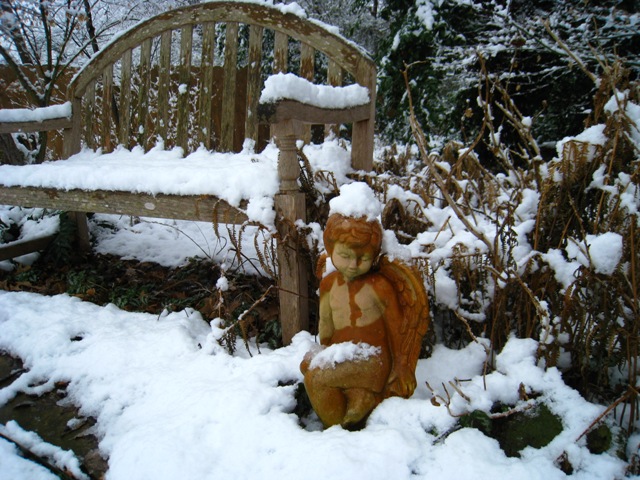
They are the permanent structures in our gardens that add interest no matter the season, such as trees, evergreen shrubs, walkways and paths, ponds, fountains, statuary, arbors, trellises, gazebos, and benches.

A flagstone pathway leads through an arbor
Evergreen shrubs line a flagstone path leading to a pond
Trees add height and structure


Evergreen trees or large shrubs have good form as well as function.  Not only do evergreens anchor a garden design and give it structure, they can serve as a screen from the neighbors, as a windbreak from harsh northern winds, or just as a backdrop for deciduous shrubs and/or perennials.

Hollies, laurels, nandinas, and other shrubs with berries also provide food for winter birds.

Possumhaw Holly loaded with berries

Just as "the leg bone connected to the knee bone and the knee bone connected to the thigh bone," so garden bones connect different areas of our gardens, tying them all together.  Garden paths, whether made of stone, gravel, mulch or grass, allow the visitor to meander throughout the garden.
Well-placed seating invites visitors to sit a spell.


Even the layout of garden beds, whether in long sweeping curves or formal straight lines, constitutes this skeleton of the garden.  Good bones give your garden visual appeal even before a single plant has gone in the ground...


...as well as after the plants have gone dormant.

Flagstone paths define the garden beds

The sweeping lines of garden beds stand out when the blooms have taken a back seat.  Ornamental grasses provide winter interest.


Shrubs form an evergreen skirt around the house

 When there is no competition from foliage,
the beauty of tree bark comes to the forefront, as well. 
What once went unnoticed in our gardens now captures our attention.

Rough bark of Chinese Pistache
Red twigs of 'Sango Kaku' Japanese Maple

Cinnamon bark of 'Natchez' Crape Myrtle

Large boulders seem to pop out of the landscape once again when the surrounding plants have gone dormant.


Trellises and other garden ornaments add interest to our gardens whether they are dusted with snow or accompanied by foliage or blooms.


Could your garden use a little backbone? 

During this time when our gardens are dormant, look around at those blank spaces that are left behind, and see where you can incorporate some garden bones.  

It just might breathe a little life into your garden... 
even in the dead of winter.

Until next time...

Toni :-)

Monday, October 11, 2010

Fall is the Time to be Wild About Spring!


Wild about spring wildflowers, that is!   

Wildflower seeds are sown in the fall in order to germinate and grow over the winter and then put on a  show in the spring (at least that's how we do it in Zone 7b/8a).

I got my first batch of wildflower seeds from Wildseed Farms in Fredericksburg, Texas.  It contained an assortment of seeds...poppies, larkspur, bluebonnets, corn poppy, California poppy, bachelor buttons, and scarlet flax to name several.  After letting them grow and bloom, I decided that there were only a few of them that knocked my socks off, so I saved the seeds from those varieties only.

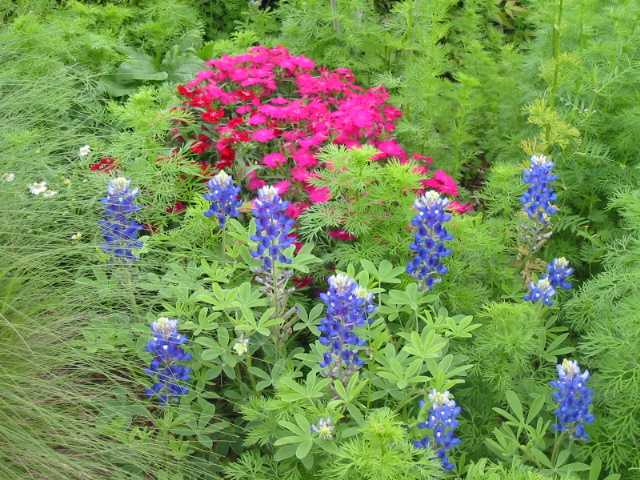
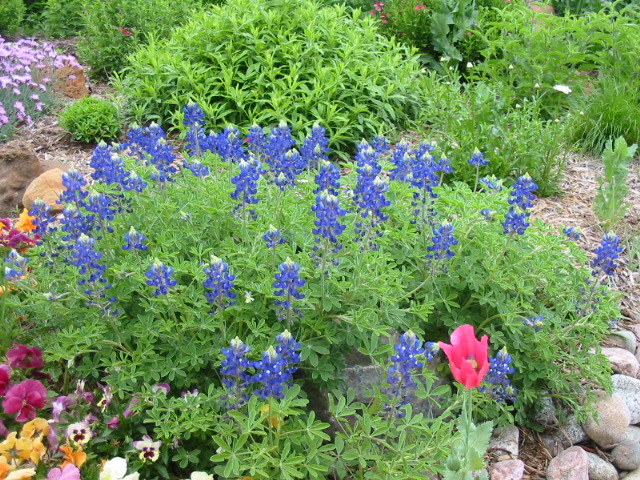
California poppies, larkspur and, of course, bluebonnets (state flower of Texas!!) stole the show and have been allowed encore performances in my garden ever since.

Then a friend of mine introduced me to her red Somnifera poppies (and I just had to have them in my garden), so I made another addition to the wildflower lineup.

The wildflowers faithfully reseed and bloom among my perennials every spring, starting in late March with the bluebonnets, then the poppies and larkspur in April, blooming all the way through May.

Here are some photos of the wildflower display in my garden each spring. 
  
These are the Somnifera poppies that blomed in my garden this past April.   
In this photo you can see several stages of blooms.  About halfway up toward the right side you can see the bent over bloom bud (they stand upright just before the bloom opens).  There are freshly opened blooms, ones in the process of going to seed, and finally the seed pod.

These are the dried seed pods.  The "sunburst" shaped cap lifts up to reveal a little row of "windows."  When you tip the seed pod on its side, hundreds of tiny seeds pour out like sand.


The poppies are in bloom at the same time as perennial 'Bath's Pink' Dianthus, Irises, and Ox-eye Daisies


Golden California poppies are bright and cheerful at the front of the border.


Larkspur's tall purple/blue, pink, and white spikes put on quite a show!

Spring blooming Coreopsis makes a nice companion.


 Larkspur paired with Red Bor Kale and Pansies 
creates a colorful spring garden at my church.

And what would a Texas garden be without our state flower,
the Bluebonnet!


A spring stroll down the sidewalk becomes a wildflower garden tour :-)   


 Ox-Eye Daisies, Larkspur, and Poppies
mingle for a beautiful spring display of wildflowers.


For success with wildflowers, you will need an area with full sun, preferably at least 6 hours.

Sow the seeds in October.

Scratch the soil and then scatter the seeds, making sure they have good soil contact.   The seeds are very small, so do not cover them with more than 1/4 inch of compost.

Here's a tip for getting better distribution of the seeds:  Mix the seeds with either sand or coffee grounds and then scatter.

Water, and watch them grow.   Be sure to remember where you sowed your seeds because the young wildflower foliage looks suspiciously like a weed.  One time my neighbor, thinking he was being helpful, pulled some wildflower "weeds" for me! 

After the wildflowers finish blooming, they will set seed.  Then you will need to let them go through that "ugly" brown period where the seeds are maturing and drying.  After the seed pods have dried, you can pull the whole plant out of the garden (it won't regrow from the root, only the seed).  Then scatter the seeds back in your garden, or collect them to share with friends.

This fall day, I hope you enjoyed your stroll through my spring garden of wildflowers! 

Toni :-)